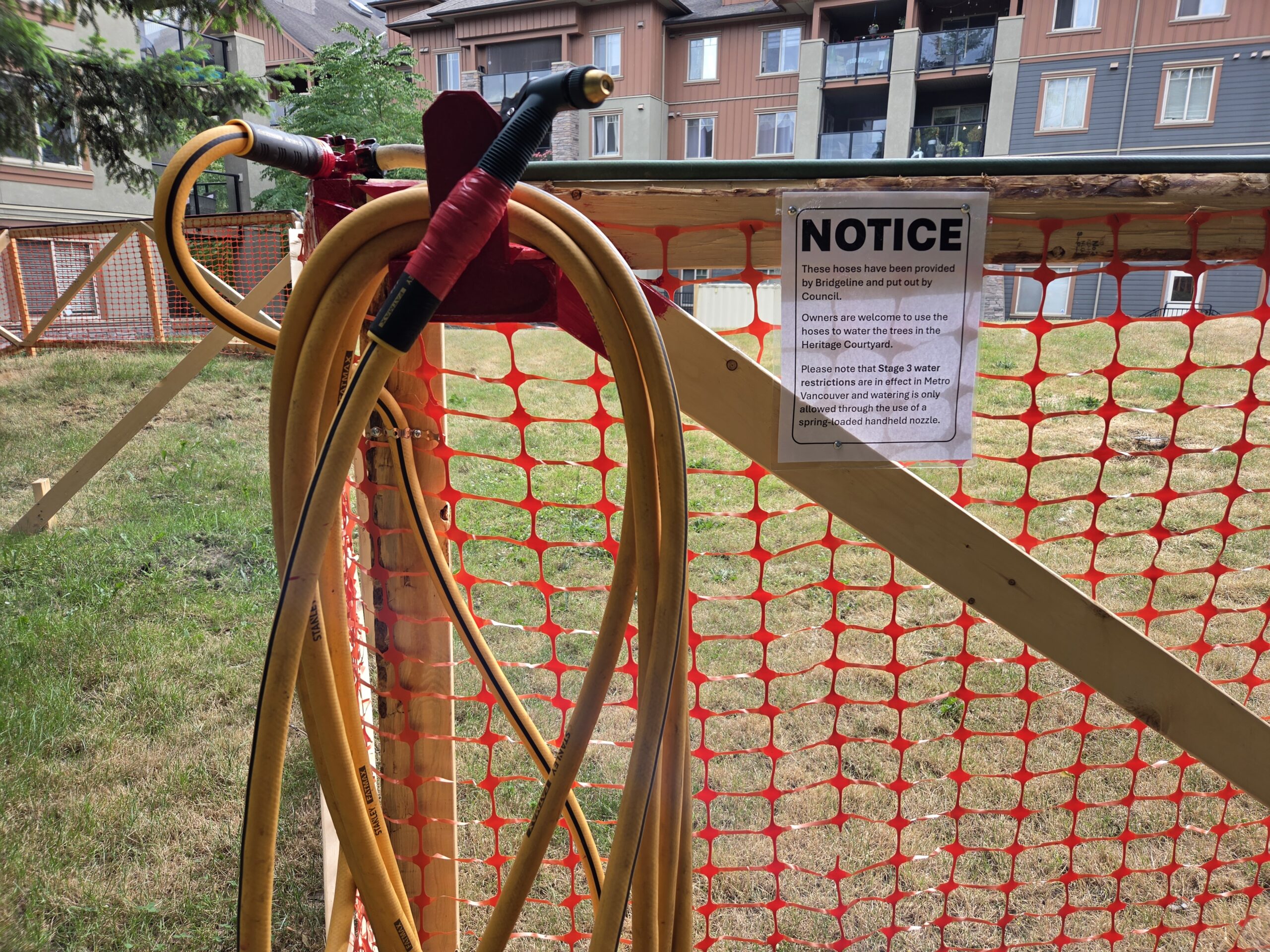
If you water the trees, thank you! Please coil and put the hoses back when you’re done. There’s no need to turn the water off or on, as the nozzles will insure the water does not leak out.
One of the two hoses, coiled up and ready to be used.
UPDATE, 1:31 p.m. The work has been completed and power is now back on in Building 248.
I have confirmed that only the 248 building will be affected by the power shutdown today, June 1, 2026. The outage is expected to last from 9 a.m. to 1 p.m.
Buildings 240 and 244 will be unaffected.
For Building 248, expect the following during the power shutdown:
Parkade gate fobs will not work– the gate sensor has been temporarily disabled to allow entry/exit without a fob during the power outage.
Door fobs will not work. Keys will work normally.
This post will be updated when work has been complete and power has been restored.
The power shutdown that was supposed to happen has been rescheduled for Monday, June 1, from 9 a.m. to 1 p.m. Here’s hoping it doesn’t get cancelled again at the last minute!
I had surgery recently and the recovery is affecting my ability to provide timely updates on the membrane project, so you may see a few days when little is being reported. This should improve over the next week as my recovery progresses.
Phase 1 completion/emergency repairs update for May 27, 2026:
Work has been more sporadic recently as decisions are being made on how to deal with inevitable issues coming up.
Patios are continuing to be addressed in terms of stripping and preparing them for post-demolition work, on both the 240 and 244 buildings.
The sidewalk in the emergency repair area is no longer going to be removed and replaced. It will instead be repaired and sealed with the same paint used for crosswalks/traffic lines (this is very thick, durable paint that provides a seal that can withstand traffic for many years).
The planter by the southeast corner of the 248 building, which was part of Phase 1, has finally been removed:
Landscaping update:
As some may have no doubt noticed, the new landscaping company, Terra Firma, has been onsite. As of today they have mowed all lawns except for the easement facing Brunette Avenue. They have been working in stages as the grass was very long, due to approximately 3.5 months of no cutting.
They will continue to come by weekly (normally on Fridays as of now) and will continue to mow, clear out brush and tend to other neglected areas around Copperstone.
Lawn cut around Building 248Lawn cut on Sherbrooke Street (looking east)Lawn cut on Sherbrooke Street (looking west)
This post will be updated shortly with more info–stay tuned.
UPDATE, May 4, 2026, 7:58 a.m. Houle has cancelled the work scheduled for today. It will be rescheduled, likely in late May or early June.
Houle Electric will be doing preventative maintenance work on Monday, May 4, 2026 in the 248 building, but this will require the power for all three buildings to be shut off, for what should be no more than four hours.
The official notice shows:
Disconnect Time: 9 a.m. Reconnect Time: 1 p.m.
It’s possible the work may not take the full time listed.
Again, all three buildings will have power shut off for at least part of Monday, May 4, 2026:
Here’s an update on the issue of water pooling during heavy rain in front of the 240 building, first covered here.
A pipe to nowhere
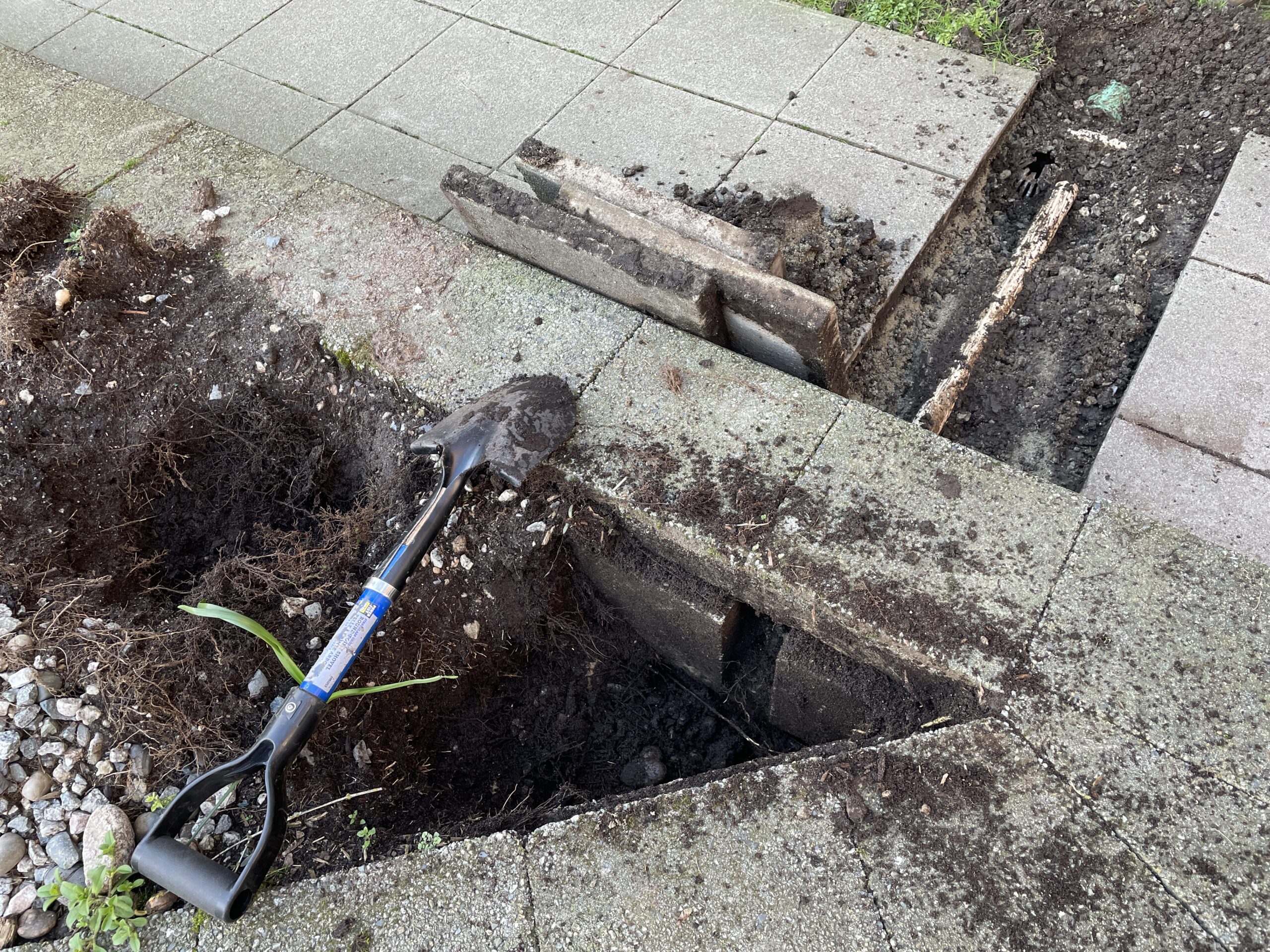
Council VP Jeff did more exploratory work in the area and uncovered some interesting things.
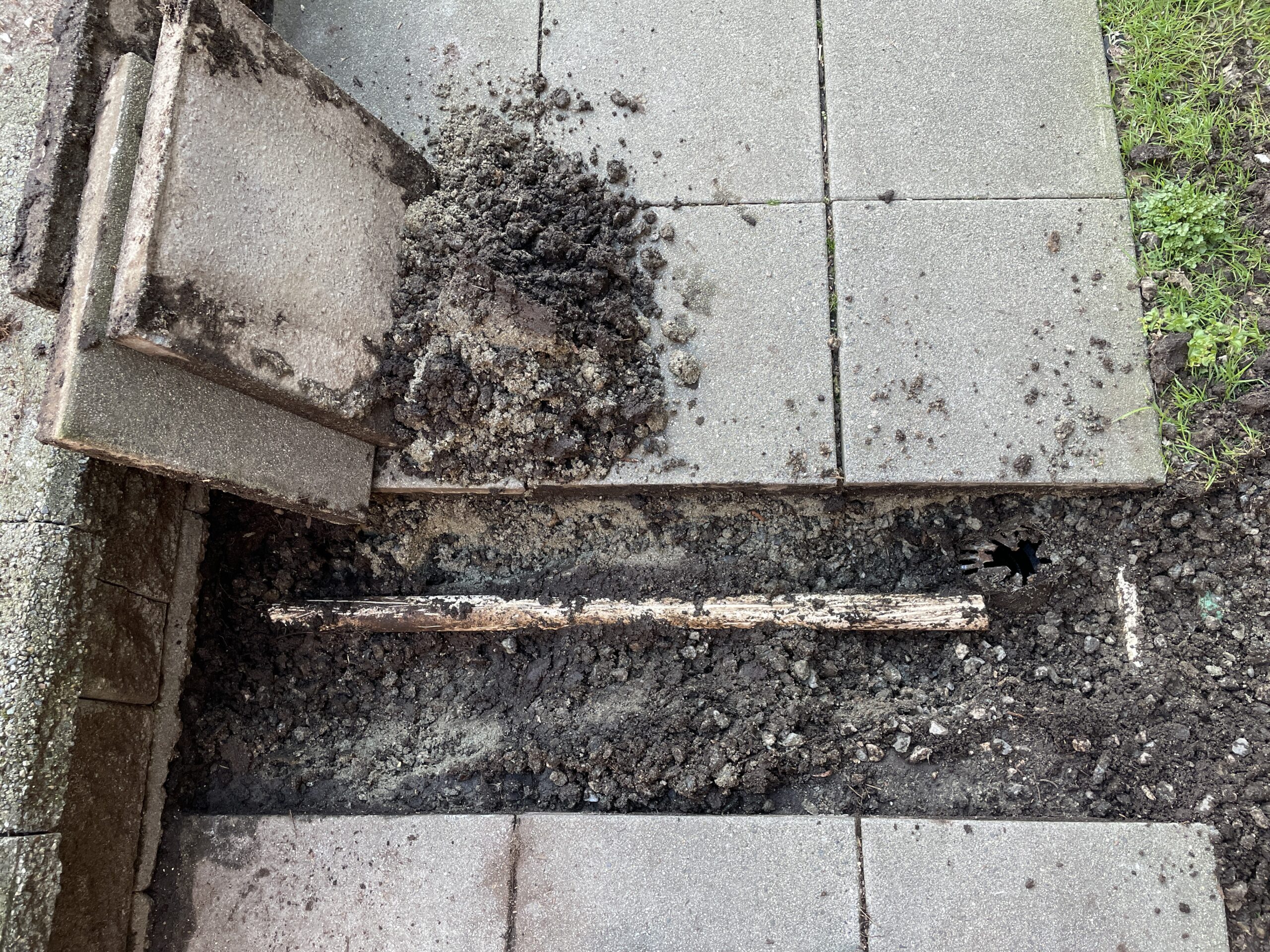
The first is a small pipe that goes from underneath the north planter in front of the building entrance to…nowhere.
It was apparently intended to feed into the drain shown in the shot below, but as you can see, it doesn’t line up with the drain at all (the other pipe partly exposed is tied to the irrigation system).
A pipe that doesn’t actually connect to the drain.
At its starting point, the pipe is not connected to anything and was 100% clogged full of dirt. Since this pipe is normally buried and does not connect to anything, it would have been impossible to keep it from clogging as designed.
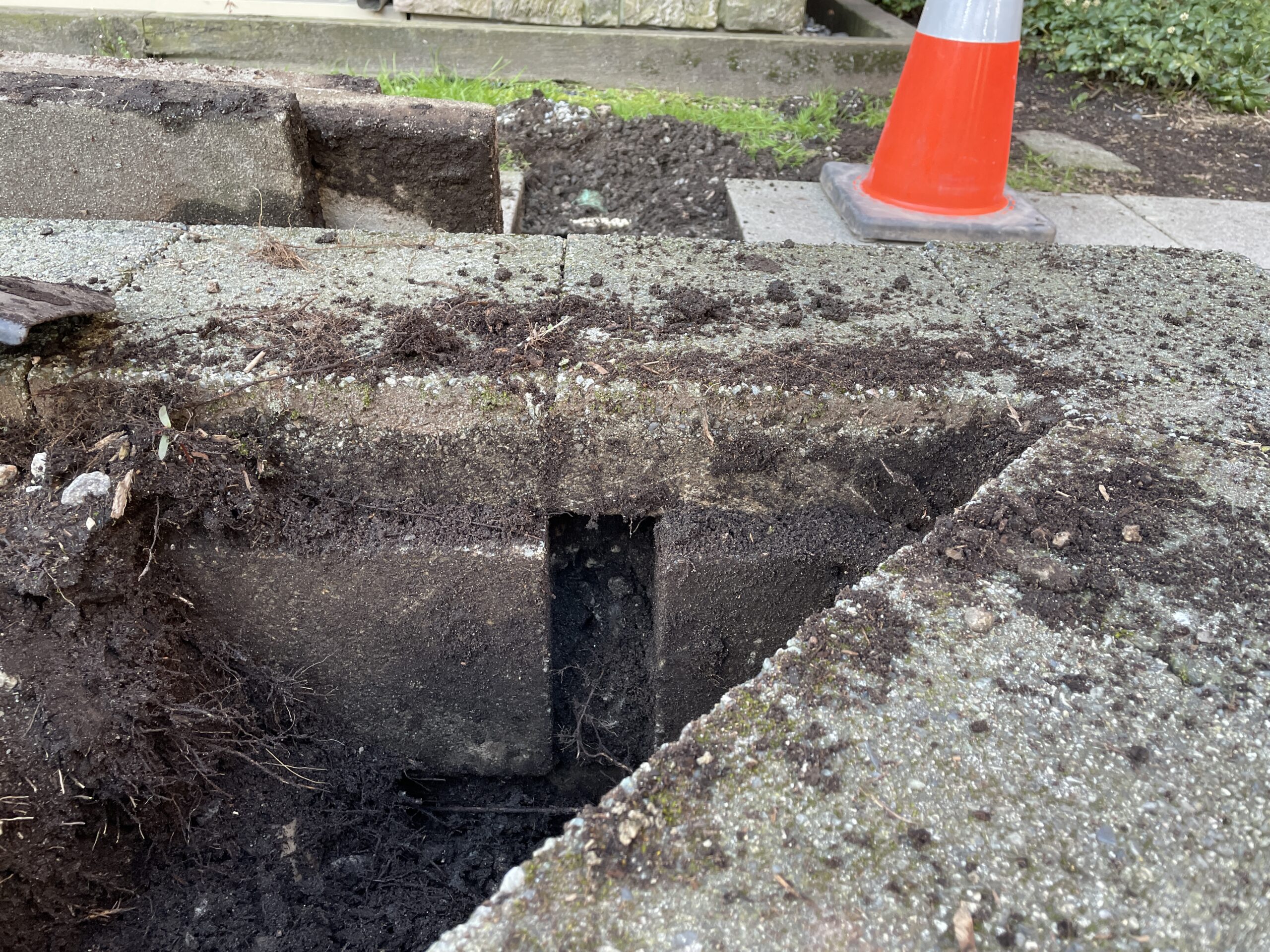
The pipe ends somewhere in the narrow gap in the Allan blocks.
The solution: Giving the pipe a purpose
The solution to this was the following:
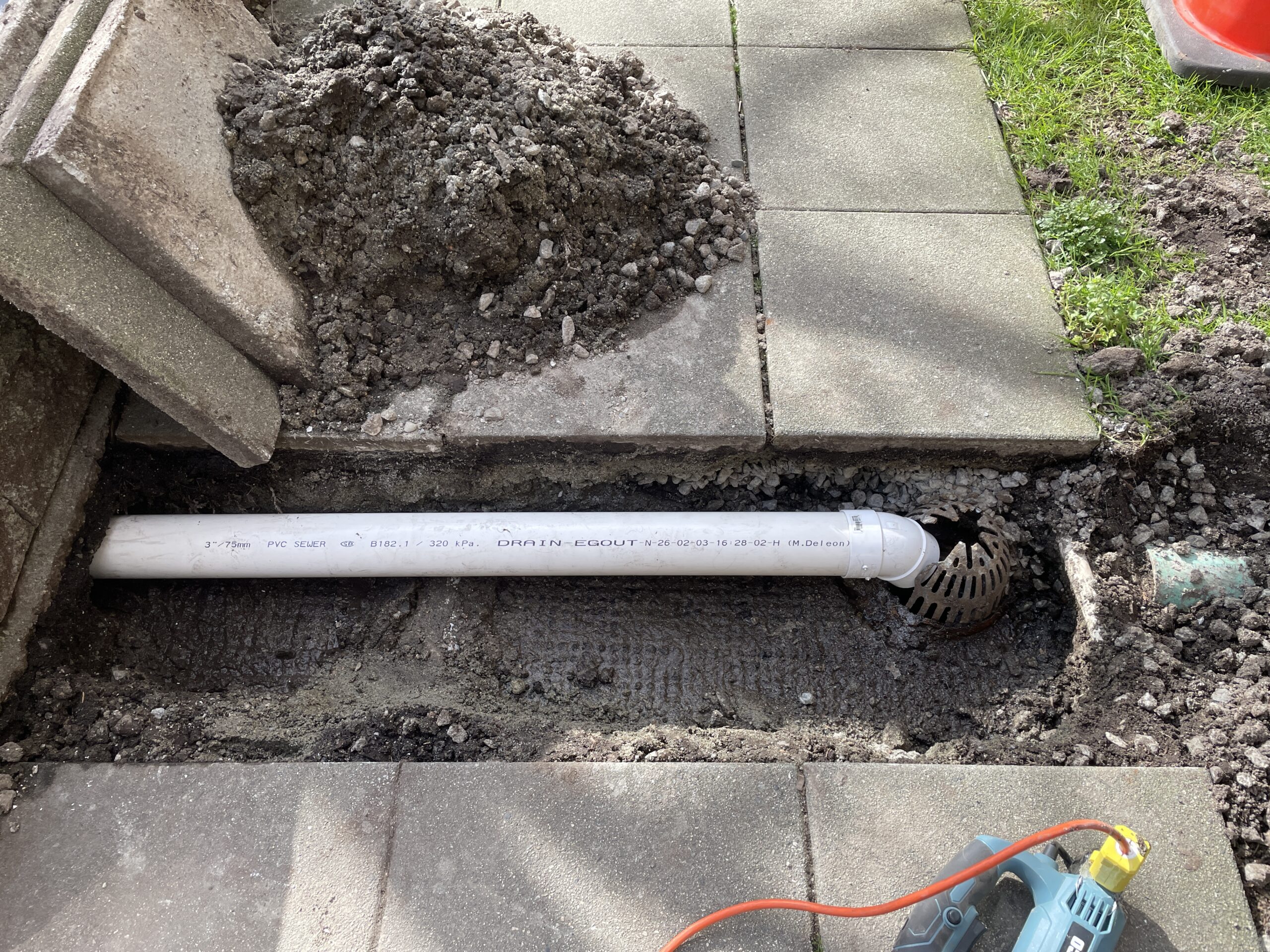
Install a larger piece of PVC pipe
Connect the PVC pipe to the drain
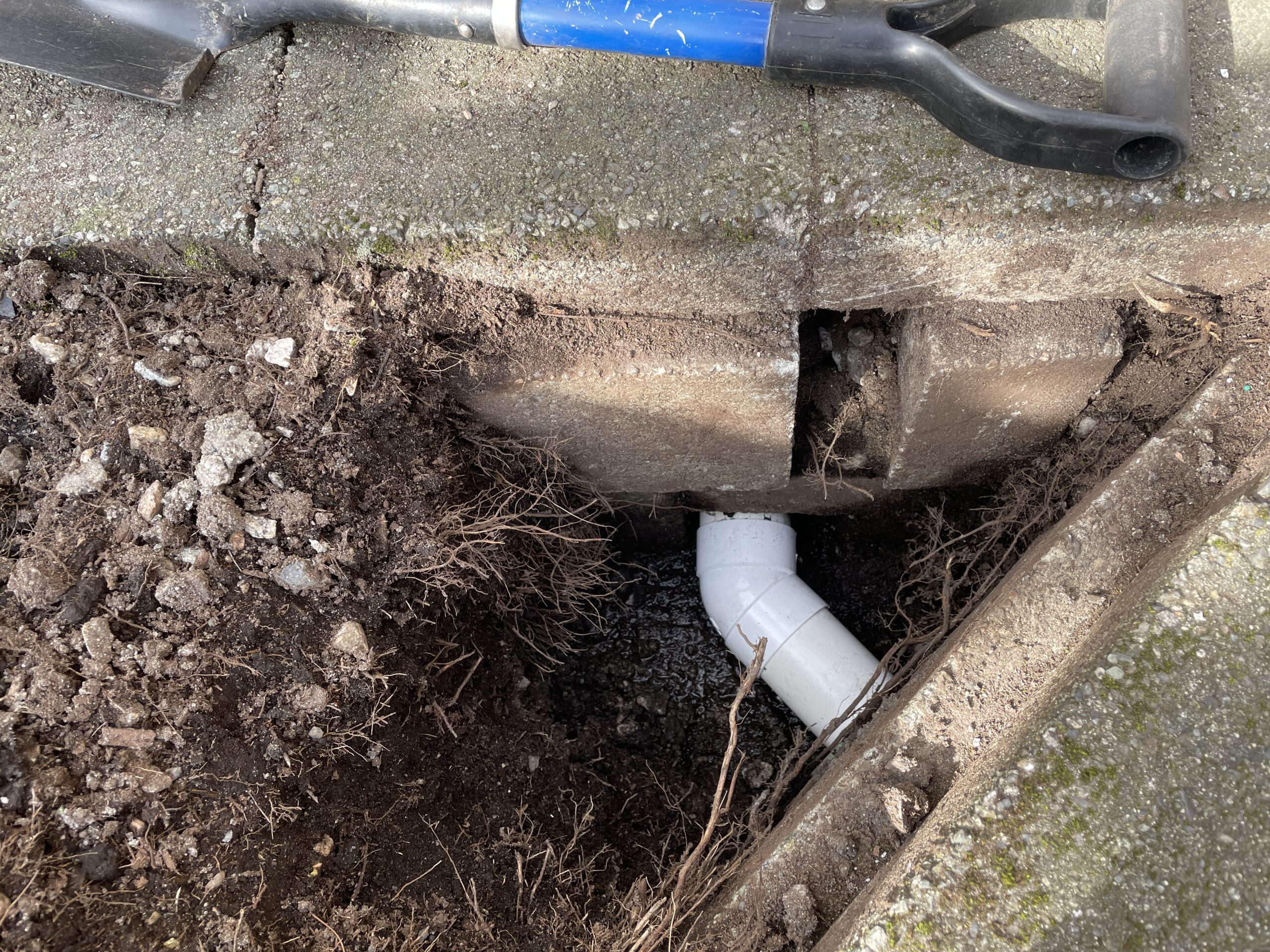
Extend the PVC pipe under the planter and connect it to a curved piece of PVC pipe that can collect and direct the water to the drain
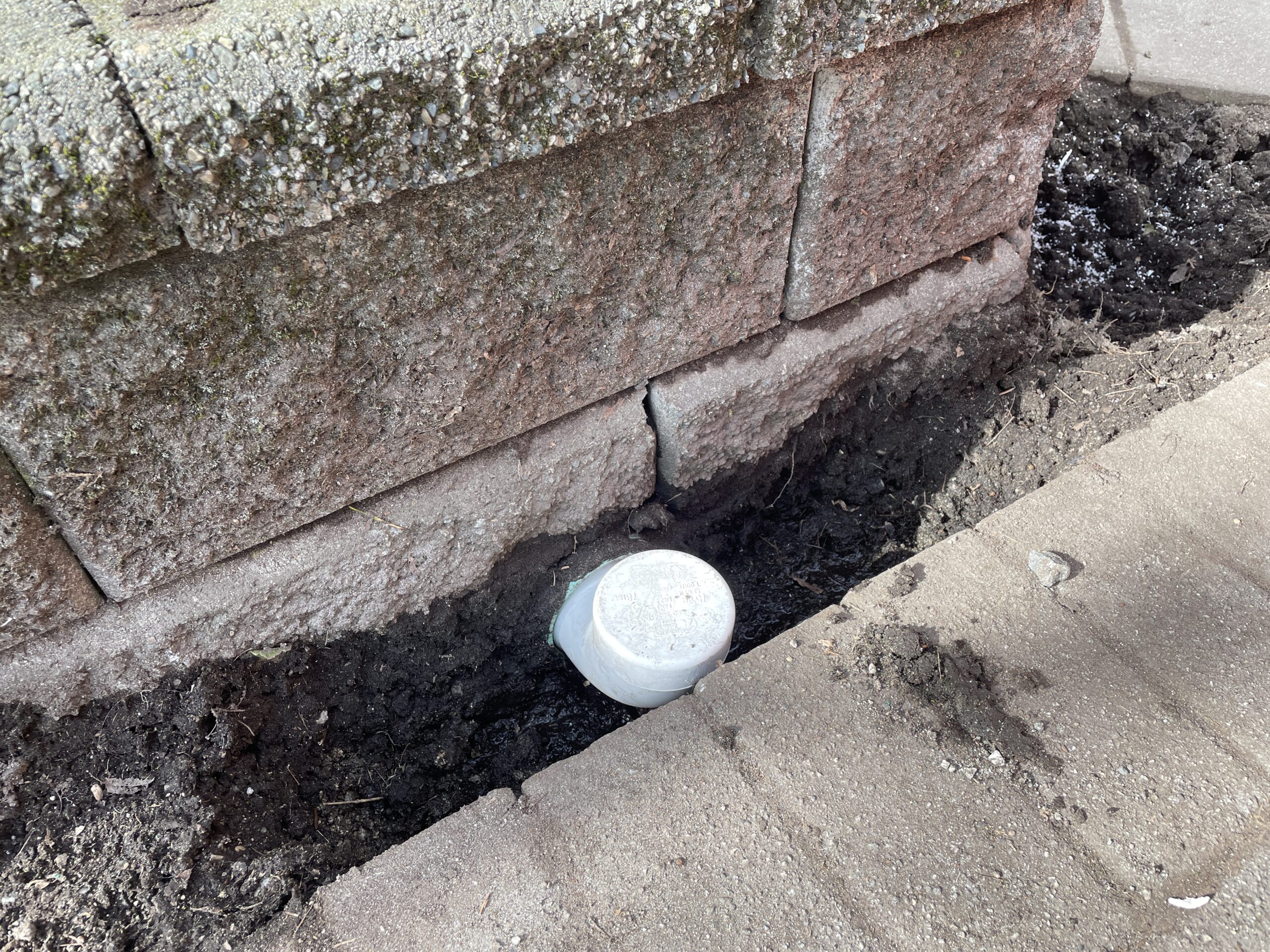
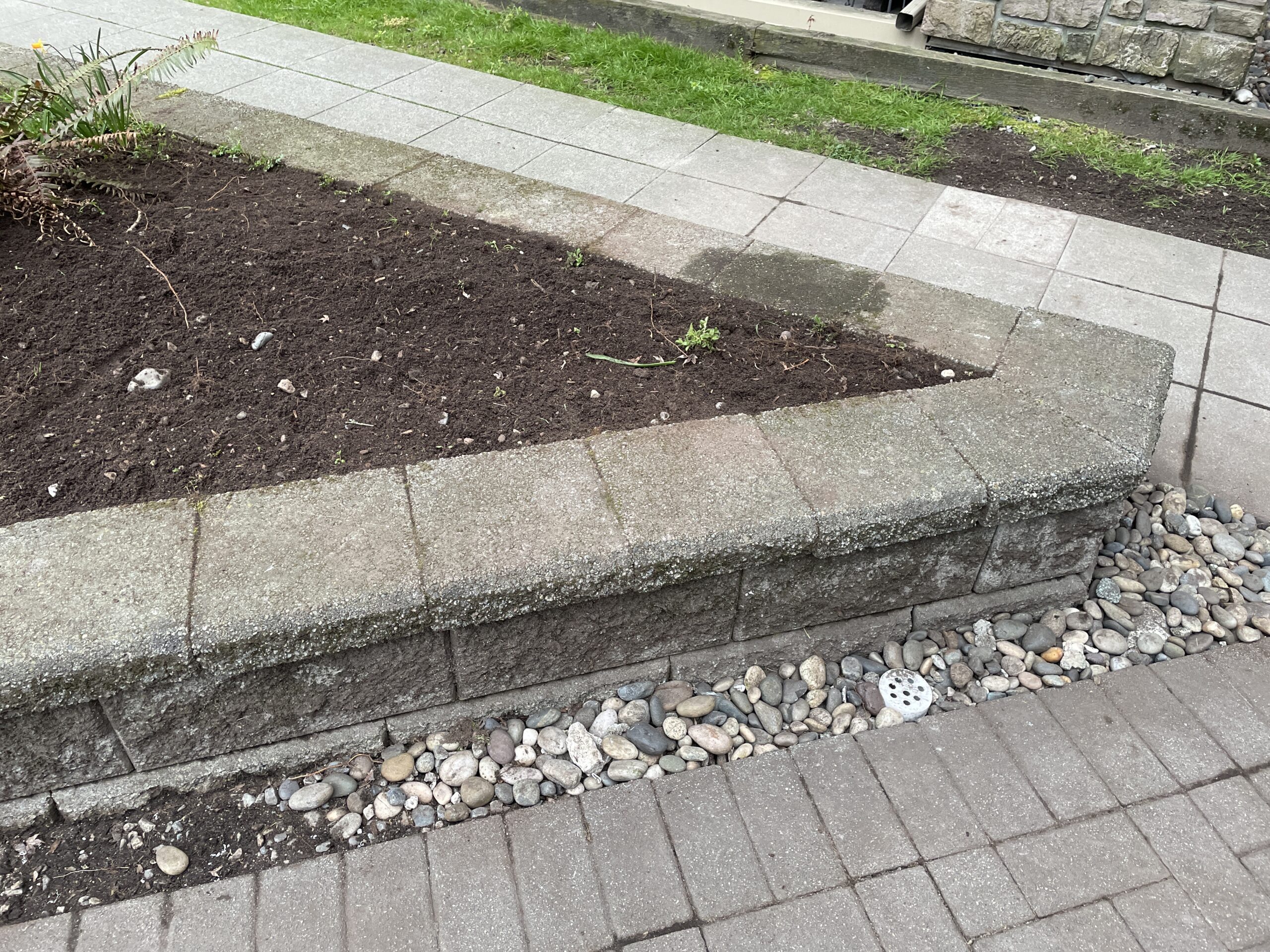
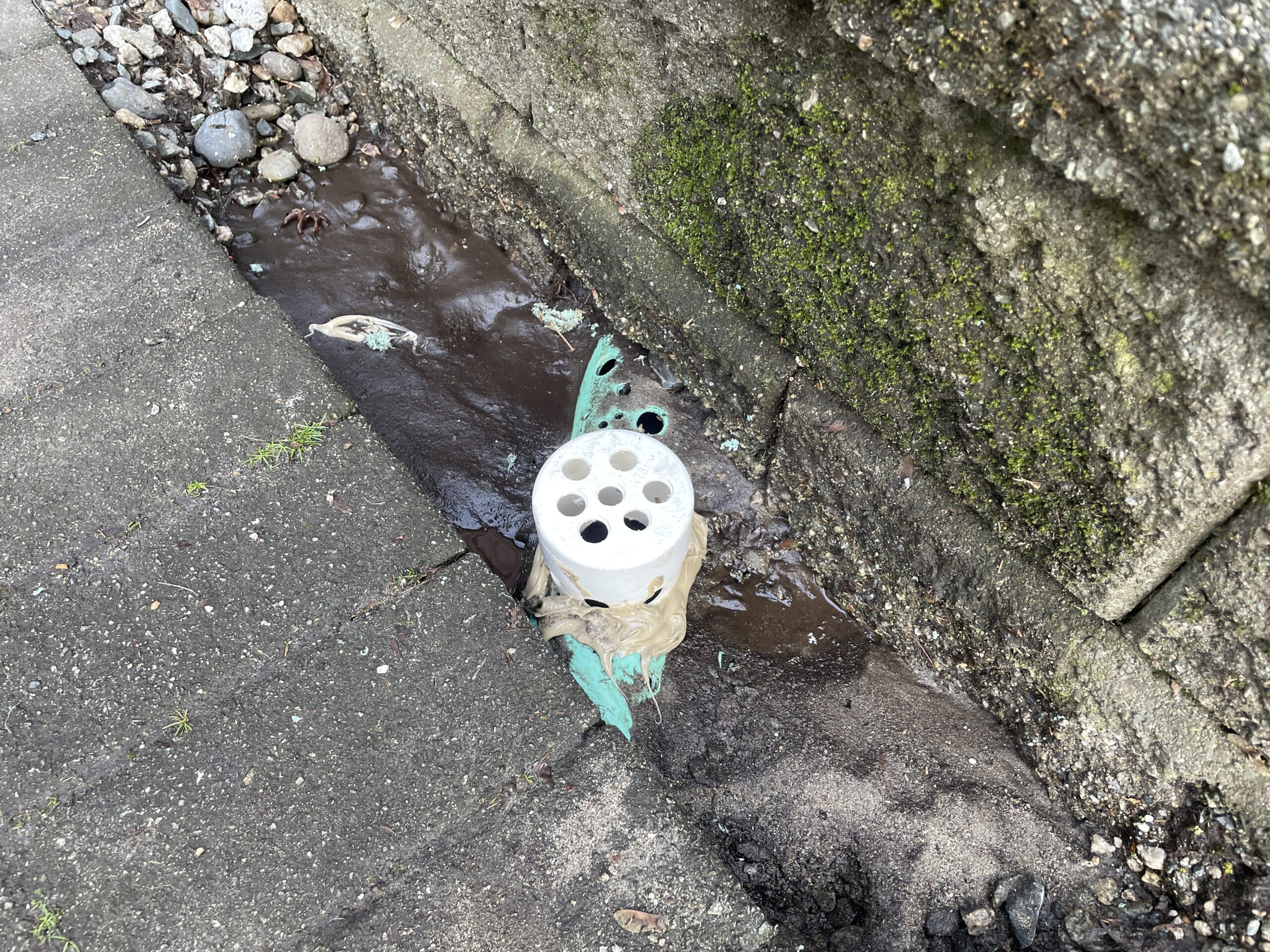
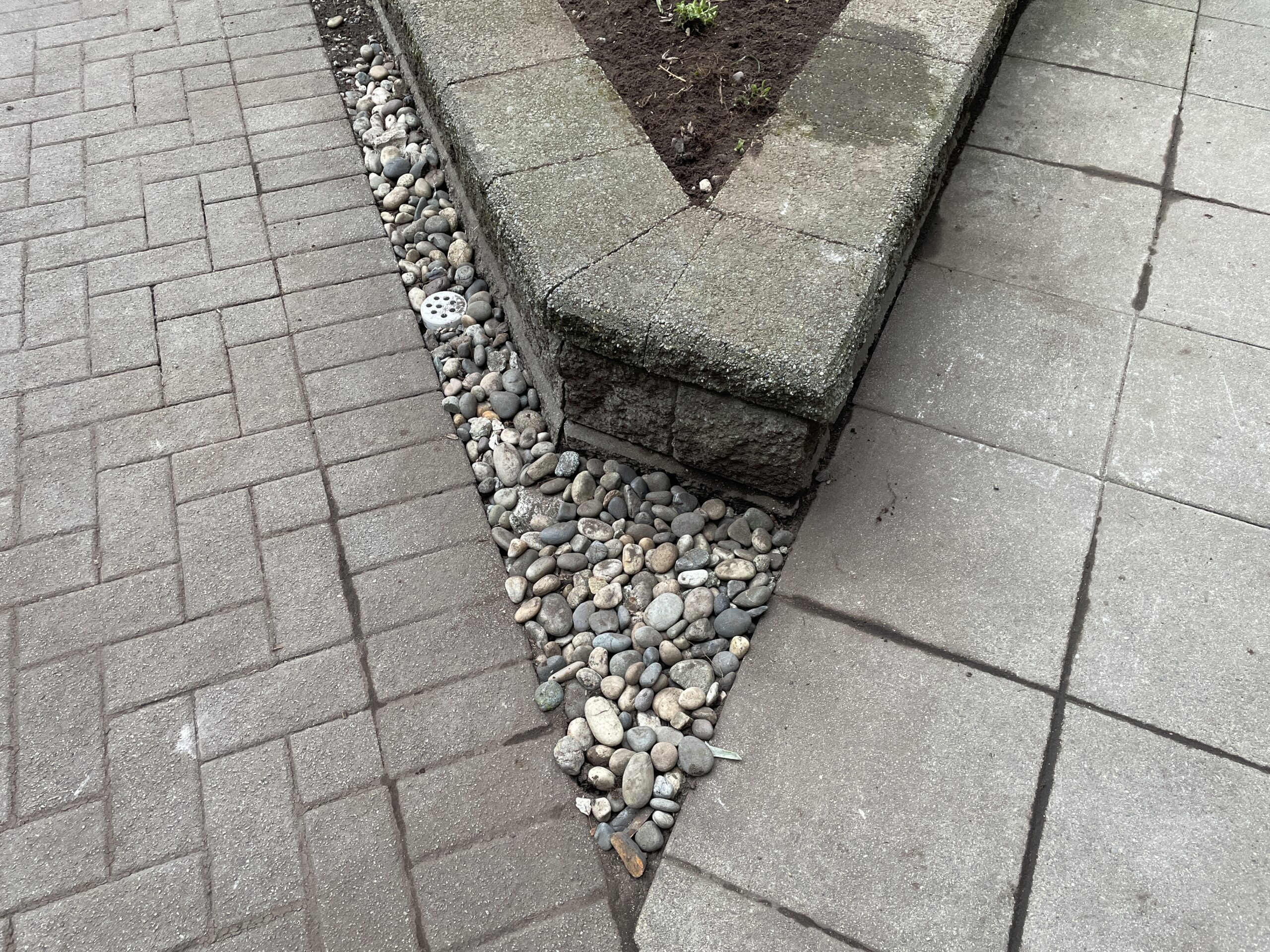
Step 1: Connect larger PVC pipe directly to the drainStep 2: Direct the new PVC pipe through the planter and out to the other sideStep 3: Cap off the pipe before drilling holes and applying river stoneStep 4: The cap now has holes to allow water entry. River stone has been placed around the cap to allow water into the new PVC pipe
The other side: Strange connections
The pipe on the north side had additional holes drilled into it and was also capped off similar to the south planter. The area will be filled with river stone when complete.
River stone will be added.
The configuration of the above pipe is rather odd:
The end that points to the courtyard quickly dead-ends
The other end appears to run to the edge of the building, where it turns up and connects to a down spout. This means that water coming down the down spout will exit out onto the area in front of the 240 building–not ideal. Jeff thinks there may be a T-pipe that is buried under the planter that is intended to direct the water to the underground parking drainage. If this is the case, that T-pipe is likely plugged (and there is no way to access it without digging).
Generally, the construction of the pipes and drains in front of the 240 building was done in a haphazard manner. Drains should not be in the planters at all and obviously all pipes should connect, not just dead end. Jeff’s fixes should provide adequate relief when heavy rains occur, until proper drains and pipes can be installed as part of Phase 2 of the membrane replacement project.
The north planter, all tidied up and ready for the next big storm.